| National Academy of Sciences report on climate change attribution - Credit: The National Academies Press |
According to Scientific American, the idea of attributing a single weather event to climate change began in 2003, with a climate expert at the University of Oxford, Myles Allen. At that time, about fifteen years ago, the main understanding among scientists was that even though it was believed that climate change had a significant impact on the weather, there was no way to determine the exact influence of climate change any individual event. The reasoning behind this thinking was that there are just so many factors that play a part in affecting the weather, including normal climate fluctuations, that it would be extremely difficult to pinpoint the blame on climate change.
 |
| Myles Allen - Credit: Environmental Change Institute |
Fortunately, eighteen years since Allen's idea, extreme event attribution is now not only possible but a major part in one of the most rapidly and expanding subfields of climate research. New reports and papers seem to be published weekly about attributing climate change to extreme weather events. It's been like opening up the floodgates; there's been an explosion of research recently.
 |
| World Weather Attribution's logo - Credit: Twitter |
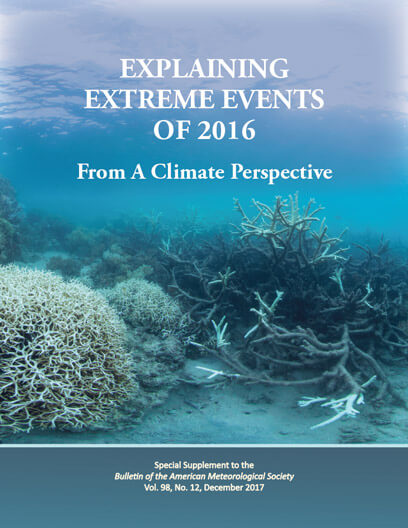 |
| BAMS yearly report on the impacts of climate change on extreme weather - Credit: AMS |
As this relatively new field still grows, the impacts that it will have on our society are still being realized. For instance, legal experts say that climate change attribution studies could play a large role in lawsuits against companies, industries, and governments.
But possibly the most important impact of this field of climate change attribution is that it will help capture the public's attention in ways that long-term projections for the future climate of our planet cannot. When most people hear the common climate change phrases that "2017 was one of the warmest years on record," that "sea levels are rising 3.4 mm per year," or that "we will limit global warming to less than 2 degrees Celsius," people either don't really understand them and the ramifications of them or they just simply don't care. However, I believe, and many scientists and researchers think, that being able to attribute specific weather events to human-caused climate change will help to make the general public more aware of the plethora of impacts of climate change. People will realize that the impacts of climate change can already be felt right now; we don't have to wait another 20 years. When they see a hurricane or a tornado or a wildfire destroy a city (maybe even the city that they live in), and then that event gets attributed to anthropogenic climate change, people may realize that climate change is impacting them right now (and that something needs to be done to stop or slow down climate change).
I think that Myles Allen sums it up nicely by saying, "I think the public and many policymakers don't really take those 100-year forecasts very seriously. They are much more seriously interested in the question of what is happening now and why—which boils down to attribution." I'm very interested in following this emerging field of climate science to see where it goes and how much of an impact it has on our society in the future.
